



Global AIOversightNow

By Gabriela Ramos
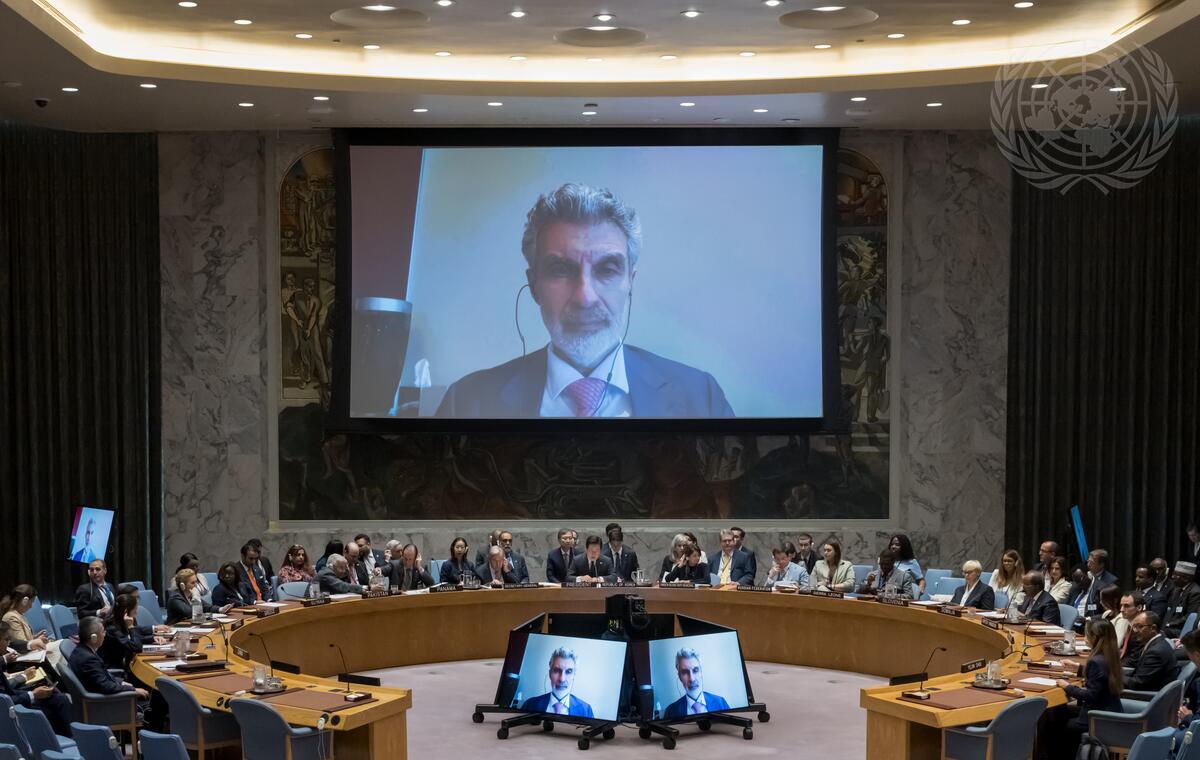
PARIS—Several years ago, Mariana Mazzucatoand I askeda simple question: Who is in charge if something goes wrong in the AI world?The question remainsunanswered, even after the United Nations Security Councilmet last week to discuss the existential risks posed by AI.
The meeting featuredthe very same tech CEOs who are now calling for a pause in AI development whilerushingtobuild ever more powerful systems in a race to the bottom. The only non-industry voice was Yoshua Bengio, co-chair of the Independent International Scientific Panel on AI anda leading advocate of AI safety.
Apart from member countries’ representatives, no one from the Global South or civil society,norany women, spoke. Thatlast omission could have been fixed by inviting the panel’s other co-chair, Nobel Peace Prize laureate Maria Ressa.
Beyond the problematic framing, the Security Council’s peace and securitymandate prevented a more comprehensive discussion of all the dangers AI may pose.
Many members noted that the Council’s work should not impinge on other UN agenciesthat are also dealing with these issues. As the old adage goes, when everyone is in charge, no one is.
The social, economic, and labor consequences of AIwere absent fromthe Security Council’sbriefing, even though they are already affecting people’s lives and can be just as serious as losing control over AI agents.
AI is reinforcing existing inequalities through algorithmic discriminationand unequalaccess to technologies, capital, and computing power.It also threatens to replace human judgment and agency while eroding our cognitive, emotional, and relational skills, as Vladimír Šucha’s workshows. And then there areits effects on young people’s mental health and the violence women endure online, as documented inthe All In report we launched at the UNGeneral Assembly.
The meeting also devoted disproportionate attention to the technologies themselves and how to fix them. Thisfocus prevents us from addressing the political and economic structures that underpin many of these problems. Long before AI came along, decades of unrestrained globalization had already favored capital over labor, concentrating income and wealth at the top while depriving mostothers of economic security.
The hands-off approachto global markets has kept low-income countries economically vulnerable while producing a few trillion-dollar companies and vast private fortunes. It has also created a political economy that resistsreform, particularly in the United States. The OECD’s 2021 agreement on a 15% global minimum corporate tax was a major step in the right direction,but that effort unraveled when President Donald Trump, immediately upon returning to the White House,withdrew the USfrom the deal, leaving tech giants to grow richer and more powerful. This is the political economy into which AI has arrived.
The UN meeting should have considered theproposalby Finland, Norway, and more than 20 other countries for common safety protocols, mandatory pre-release risk assessments, independent evaluations, and an international agency to oversee frontier AI.
Governments know how to move quickly when they want.I saw this firsthand during my years at the OECD and as chief of staff and sherpa to the G20. When criseserupted, member states did not spend years negotiating long communiquésor waiting for the perfect institutional fit. They focused on the problem at hand andwhata new bodyneeded to do. The International Energy Agencywas swiftly created in the wake of the oil shocks of the 1970s, and the Financial Action Task Force was established in 1989 to combat money laundering. More recently, the OECD’s Inclusive Framework on Base Erosion and Profit Shifting (BEPS)broughtcountries together to tacklecorporate tax avoidance, including through the 15% minimum rate.
We should take the same approach to AI. Rather than getting bogged down in procedure, we should start with what an international AI body needs to do and then give it the expertise and budget to do it. That would help us answer the challengeraised by the White House’s science and technology adviser,Michael Kratsios, who told the UN Security Council, “You cannot govern a technology you do not understand.”
The Finnish-Norwegian proposalcalls for an international institution capable of setting standards and coordinating a collective response when AI systems cross dangerous capability thresholds. It also calls for independent evaluation mechanisms. But it should go furtherby establishing mandatory risk registries and an emergency mechanismalong the lines of what the US and China are reportedly already working on. Those evaluations should also considerAI’s impact on people.
For any of this to work, the institution needs an independenttechnical body. The one serving the OECD’s Anti-Bribery Convention, for example, prepares country assessments that are approved under a consensus-minus-one rule.Countries may define global anti-corruption standards differently according to their legal traditions, but the principle of “functional equivalence” helps ensure that different legal approaches deliver comparable outcomes. The institution would also need to cooperatewith other international institutions to ensure that AI supports human development.
That leaves the question of who would represent each member state in a new international AI body. The Basel Committee for Banking Supervision works because it brings together officials with roughly the same mandate and responsibilities. There is no equivalent for AI. Only a few countries have an AI ministry, and those that exist have no capacity to investigate or sanction market behavior.
Until we develop the necessary institutions at both the national and international levels, our original question—“Who is in charge when things go wrong?”—will remain open, leaving the world exposed to unfathomable risks.
Gabriela Ramos, Co-Chair of the Task Force on Inequalities and Social-Related Financial Disclosures, is a former assistant director-general for social and human sciences at UNESCO, where she oversaw the development of the Recommendation on the Ethics of AI, and a former OECD chief of staff and sherpa to the G20, G7, and APEC.
Copyright: Project Syndicate, 2026.
www.project-syndicate.org